West Thumb Geyser Basin
The West Thumb caldera (volcanic crater) lies within one of the world's largest caldera. Most of central and southern portions of the park are within this caldera. Most of Yellowstone's present state is due to this caldera and the lava that eventually filled it. The massive eruption took place approximately 600,000 years ago.
Like many geyser basins in Yellowstone, West Thumb geysers exist because of volcanic faulting. The basin is on the inside edge of the 45 by 30 mile Yellowstone caldera. When the caldera last erupted 630,000 years ago, the floor of the giant crater dropped downward more than 1,000 feet along a ring-shaped fault. The heat that drives West Thumb's geysers and hot springs is believed to rise from hot rocks in the crust via fractures created by the caldera eruption and subsequent smaller, explosive eruptions.
Offshore is Yellowstone Lake's West Thumb, a circular basin connected to the rest of the lake by a channel. The lake's West Thumb occupies a crater formed by an eruption about 150,000 years ago. The area around West Thumb also has experienced several lesser but still impressive eruptions called phreatic or steam eruptions. Water flowing underground through hot rock is converted to steam. If there is no outlet for this steam to reach the surface, pressure builds until a steam explosion occurs, blowing out overlying rock to create a crater.
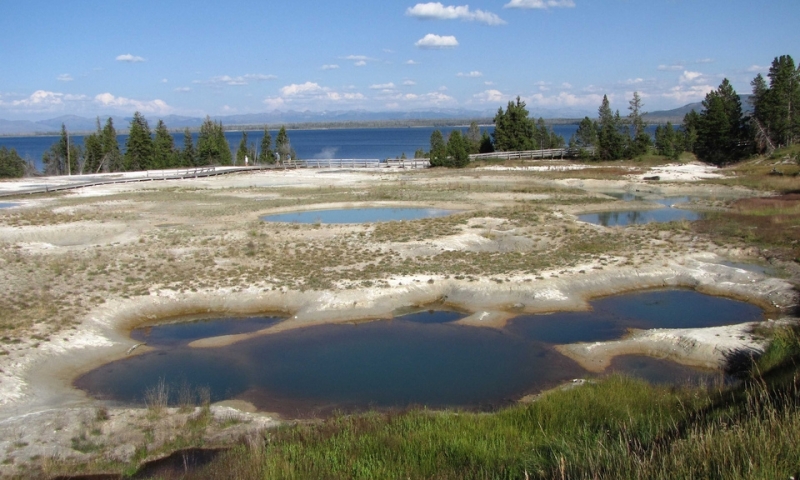
Measurements show hot rock still exists beneath West Thumb. The amount of heat flowing upward from the lake bottom is about thirty-five times greater than the heat flow from the ground elsewhere in the Rocky Mountains. A walk through West Thumb Geyser Basin provides abundant evidence in its hot springs, small dormant geysers, and mud pots that West Thumb is a living entity. West Thumb Geyser Basin is notable for a unique series of geysers. Some are situated right on the shores, some overlook the lake, and some can be seen beneath the lake surface. Three of the shoreline geysers, the most famous of which is Fishing Cone, are occasionally marooned offshore when the lake level rises. Fortunately, the area is surrounded by a half a mile of boardwalks, so it is easy to negotiate.
Lone Pine Geyser is the largest frequent geyser at West Thumb Geyser Basin. It is located a few hundred yards north of the main boardwalk portion of the basin between the road and Yellowstone Lake. Its picturesque appearance and unexpected location along the lake often leads to traffic jams during its eruptions. On the shore of Yellowstone Lake is Fishing Cone, a small dormant geyser, where early park explorers supposedly caught fish in the lake, then cooked them in the hot water flowing from the hot spring. Such cones are made of minerals deposited by hot springs and geysers. Fluctuating lake levels often submerge Fishing Cone.
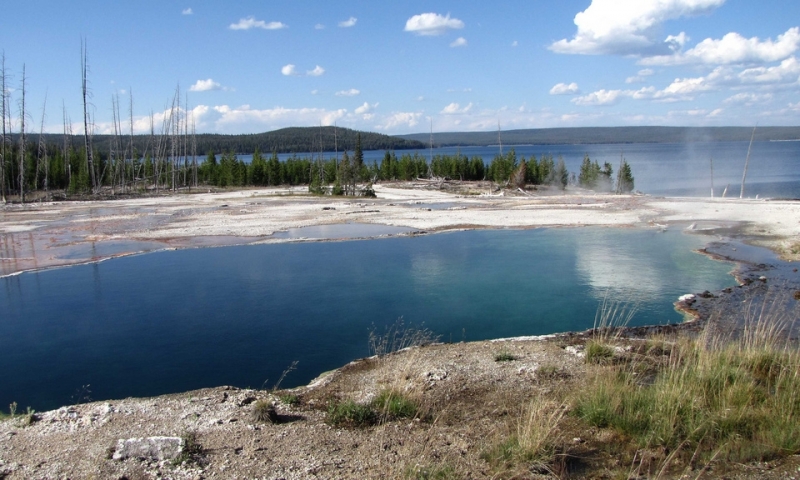
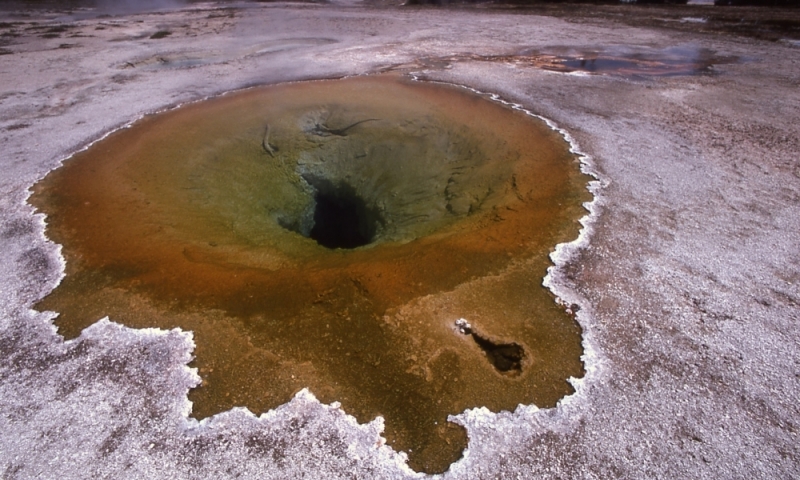
West Thumb's hot springs, like others in Yellowstone, are brightly colored by cyanobacteria, commonly called blue-green algae, and other microbes that thrive in hot water. Different microbes grow at various temperatures, so a pool's color can be used to estimate its temperature. Like other mud pots in Yellowstone, West Thumb Paint Pots were produced when rock was dissolved by acids in hot water and steam, and are constantly changing. In the 1920s and 1930s, West Thumb Paint Pots were very extensive and active. Now they are less active but, depending on moisture, they still build mud cones.
Scientists have noted the temperatures and water discharges from West Thumb's geysers and hot springs vary more than other hydrothermal features in Yellowstone, possibly because of periodic infiltration of water from the lake and earthquakes that shake the basin's plumbing system. Since the mid 1970s, West Thumb has decreased in thermal activity. Some temperatures have cooled in the basin allowing large colonies of algae and cyanobacteria to grow. As a result, large newly-formed microbial mats flourish on the runn-off channels and along the edges of pools.
West Thumb has less geyser activity than other basins, but offers a complete variety featuring hot springs, pools, mud pots, fumaroles and lake shore geysers. West Thumb Geyser Basin is one of the smallest geyser basins in Yellowstone, yet its location along the shore of Yellowstone Lake ranks it as the most scenic.
Content Error? let us know OR write for us!