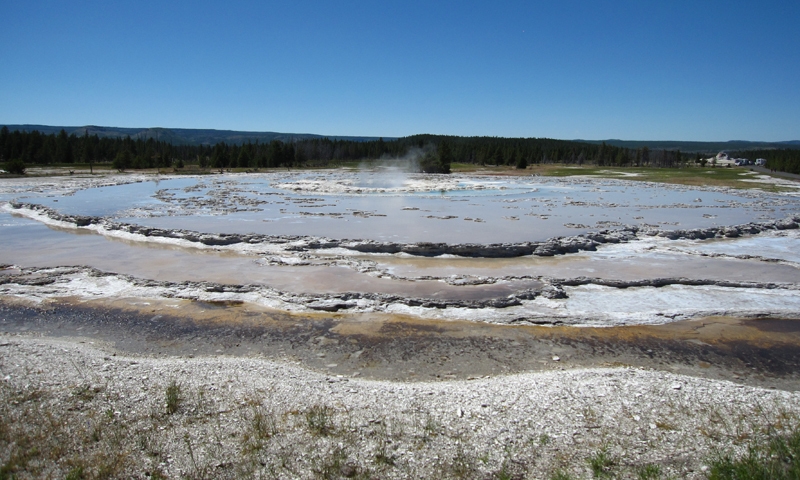
Lower Geyser Basin
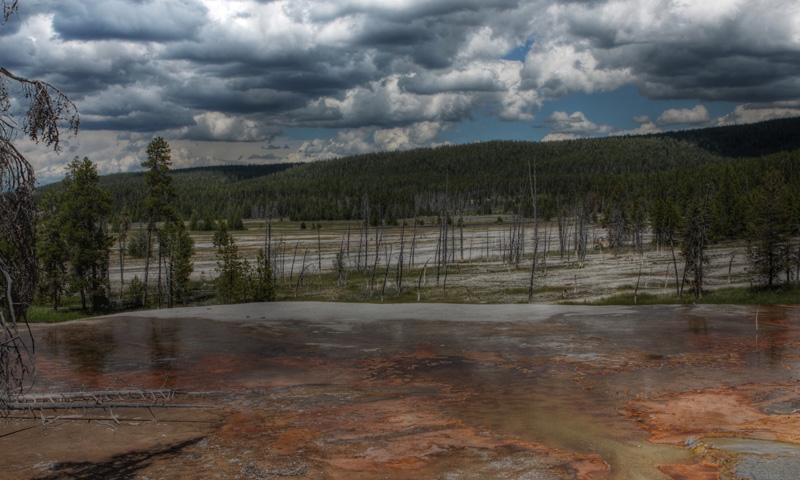
The geyser region of Yellowstone National Park occupies the ancient Yellowstone Caldera. There are spectacular views from here of burned forest on high, flat volcanic plateaus. Most geyser basins in Yellowstone exist because of volcanic faulting. When the caldera last erupted 630,000 years ago, the floor of the giant crater dropped downward more than 1,000 feet along a ring-shaped fault. Yellowstone remains alive as a tremendous amount of heat flows from the ground. The entire floor of the caldera huffs upward and puffs downward over decades as molten rock, hot water, and steam move through conduits at various levels beneath the caldera, from a few miles deep in the crust to perhaps a couple hundred miles deep in the mantle. The shallowest hot water and steam erupt to the surface as everchanging geysers, springs, mud pots, and steam vents.
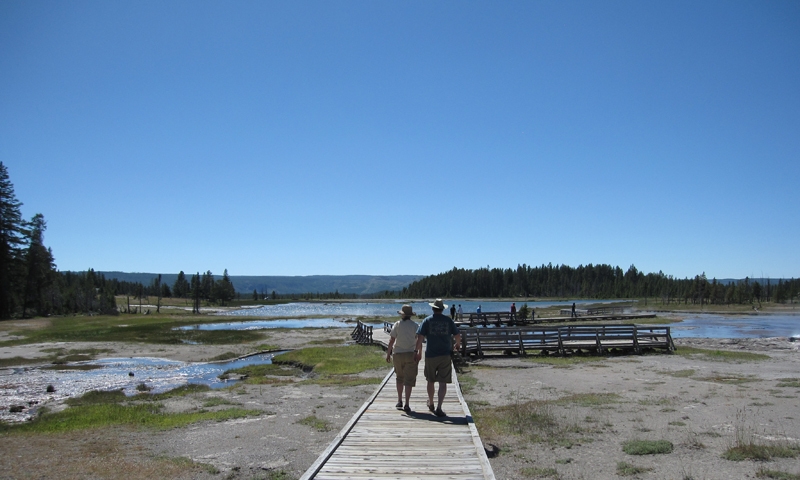
Yellowstone National Park is home to the world's largest concentration of thermal features. Old Faithful is the most distinguished in the park, though it is not the largest geyser in the park and seems less inclined these days to be faithfully regular, its image has been seen on everything from postage stamps to whiskey bottles. The Old Faithful area is generally divided into four sections: Upper Geyser Basin, which includes Geyser Hill, Black Sand Basin, Biscuit Basin, and Midway Geyser Basin. This basin region is connected by paved trails and roads, with fairly level hikes that are relatively short in distances. Between Old Faithful area and Madison Junction, you will find the justifiably famous Lower Geyser Basin, including Fountain Paint Pot and the trails that surround it. Some of these geysers can be seen on the Firehole Lake Drive, the only area in the park that geysers can be viewed from the road.
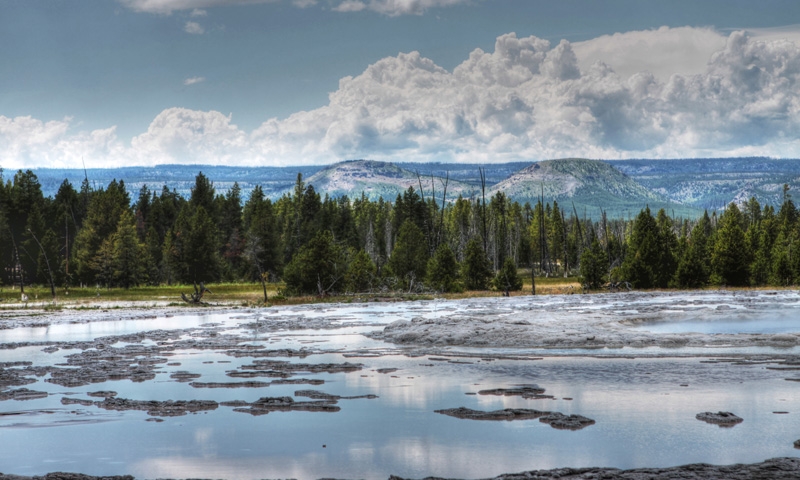
The Lower Geyser Basin encompasses nearly 12 square miles. Most of the thermal features are widely scattered in small groups and offer a large variety. Mud pots, geysers, pools, springs, and fumaroles can be seen the Lower Geyser Basin. The significant thermal features in the basin area are Queens, Laundry and Sentinel Meadows, Sentinel Cone, Ojo Caliente, Pocket Basin Mud Pots, Imperial Geyser, Spray Geyser, Octopus Spring, Great Fountain Geyser, White Dome Geyser, Pink Cone Geyser, Bead Geyser, Narcissus Geyser, Steady Geyser, Silex Spring, Fountain Paint Pot, Fountain Geyser, Clepsydra Geyser, and Jelly Geyser.
There is only one predicted geyser in the Lower Geyser Basin, Great Fountain Geyser. Great Fountain's predictions are posted at the Old Faithful Visitor Center. Great Fountain is located about 8 miles north of Old Faithful on the one-way Firehole Lake Drive. The geyser's eruption is grand, erupting from a large, terraced platform with massive bursts exploding up to 150 feet high. It is the only predicted geyser in Yellowstone National Park that you can drive to and watch from the car. Another geyser that is stunning in the area is White Dome Geyser. The geyser does not have spectacular eruptive displays, but it does have one of the largest pink and white streaked cones in the park.
Fountain Paint Pot provides visitors the best view from any road in the park of the mud pots. Mud pots are found at the highest points in a hydrothermal basin. That puts them above the water table, so they contain only water from condensed steam or the ground surface. The water becomes acidic, breaking down rocks and minerals to form mud. Over many years, a muddy spring becomes a mud pot. Farther up the trail are Clepsydra, Fountain, Morning, and other geysers. Clepsydra erupts frequently, and offers a spectacular and colorful display.
Nearby to the Fountain Group is the largest collection of mud pots in Yellowstone, Pocket Basin Mud Pots. Pocket Basin Mud Pots is an isolated group along the Firehole River, with no designated access to this very fragile and delicate area. The basin was formed by a hydrothermal explosion, a result from overheated ground water that exploded into steam, leaving a crater-like basin.


network of Travel Guides