Old Faithful Geyser
Old Faithful is the most popular attraction of Yellowstone National Park. Although it is the most photographed and most talked about, Old Faithful is not the largest or most grand geyser. The Upper Geyser Basin, Black Sand and Biscuit Basin offer much more sights to see than just Old Faithful. The following are just some examples of the other geothermal features of the Old Faithful area. To truly experience all that Old Faithful has to offer, get out of your car and walk the boardwalks. The display of natural wonders is worth the short hike. There are boardwalk guides available for a 25-cent donation at the visitor centers and the entrances to the trails and boardwalks.
Upper Geyser Basin
Old Faithful
- The infamous geyser got its
name because of its punctuality and predictability. Old Faithful erupts more frequently than other large geysers. Contrary to popular belief Old Faithful is not the
largest geyser in the park. Eruptions at Old Faithful last anywhere from 1 to 5 minutes, and sprays water and steam up to 184 ft vertically. The average interval of Old
Faithful was every 76 minutes. An earthquake occurring in the winter of 1998, effected the time interval of Old Faithful. Eruptions now occur approximately every 80
minutes.
Anemone Geyser - The cycle of eruption of this geyser repeats every 7-10
minutes. The cycle of eruption is typical of most geysers. The pool fills and overflows and bubbles cause splashing. The rate of splashes increases and the water is
thrown into the air. Anemone geyser spouts water ten ft in the air. Water then drains and the cycle begins again.
Plume Geyser - Plume Geyser erupts approximately every 20 minutes. You must pay
attention because the eruption consists of 3-5, 25ft bursts.
Beehive Geyser - Beehive Geyser erupts twice a day. This fascinating eruption
consists of a powerful stream of water projected up to 150 ft in the air.
The Lion Group - The Lion Group contains four separate geysers that are all
interconnected underground. The group consists of the Lion, Lioness, Big Cub and Little Cub. The lion exhibits the largest eruptions. This geyser family got its name
from the deep roaring sound the geyser makes after an eruption has occurred.
Giantess Geyser - If you miss this one, don't worry the infrequent and
violent eruptions only happen 2-5 times a year. When an eruption dies occur, the surrounding area make shake from the underground steam explosion. This fountain like
geyser propels water 100-200 ft in the air in a series of bursts.
Castle Geyser - Castle may be the oldest geyser in the basin. It also has the
largest cone of any geyser. Eruptions reach 90 ft and last approximately 20 minutes. The water phase is followed by steam, which can last 30-40 minutes. Castle
Geyser erupts every 10-12 hours.
Grand Geyser - Often overshadowed by Old Faithful, Grand Geyser is the largest
most predictable geyser in the world. Grand erupts from a large pool with powerful gusts. Eruptions occur every 7-15 hours and last 9-12 minutes.
Daisy Geyser - Daisy eruptions are unique in that they erupt on an angle, and
reach a height of 75 ft. Daisy is predictable with eruptions occurring every 90-115 minutes.
Riverside geyser - The most picturesque geyser in the park is Riverside geyser.
An eruption causes an arch of steam and water to cascade over the Firehole River. Eruptions are about 5-6 hours apart.
Morning Glory Pool -
Morning Glory was one the most glorious pool in the park, hence the name. Unfortunately man has
destroyed the beautiful, clear, colorful spring. The ultimate example of the impact humans have on nature. Visitors have thrown rocks, coins, trash, logs, and other
debris, which has clogged the natural plumbing of the pool. Water is unable to circulate and therefore thermal energy is lost. The drop in temperature has allowed
yellow bacteria to grow in Morning glory. If you see any signs of vandalism to any of the geothermal features report them to a Ranger.
Black Sand Basin
Only one mile from Old Faithful lies the Back Sand Basin. The area's sand is reminiscent of volcanic activity in Yellowstone.
The main features of this basin are Emerald Pool, Sunset Lake, and Rainbow Pool.
Biscuit Basin
Biscuit Basin is located three miles north of Old Faithful. Main features here include Jewel Geyser, Shell Geyser, Avoca Spring,
Mustard Spring, and Sapphire Pool. Biscuit Basin is named for the biscuit-like deposits that once surrounded Sapphire pool. The "biscuits" were blown away in
the earthquake of 1959.
Trails and Boardwalks
| Trail | Miles | Kilometers |
| Distance from Visitor Center | ||
| Old Faithful Geyser Loop | 0.7 | 1.1 |
| Geyser Hill Loop | 1.3 | 2.1 |
| Observation Point Loop | 2.1 | 3.4 |
| Morning Glory Pool | 1.4 | 2.2 |
| Lone Star Geyser | 4.3 | 6.9 |
| Fern Cascades Loop | 3.0 | 4.8 |
| Distance from Trailhead | ||
| Black Sand Basin | 0.6 | 1.0 |
| Biscuit Basin Loop | 0.6 | 1.0 |
| Mystic Falls | 1.1 | 1.8 |
| Lone Star Geyser | 2.3 | 3.7 |
| Mallard Lake | 3.3 | 5.3 |
Old Faithful Inn
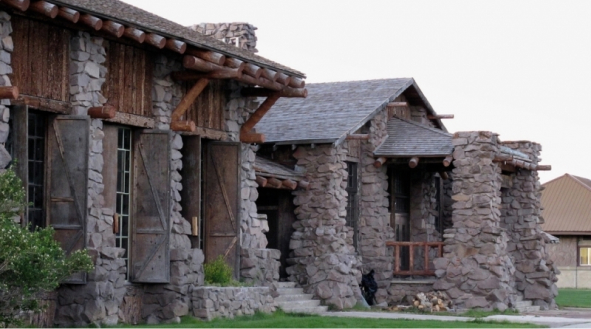
The spectacular Old Faithful Inn is within short viewing distance of Old Faithful Geyser, the most famous geyser in the United States. Built at the turn of the of the century, the Inn is a National Historic Landmark and is one of the few remaining log hotels in the United States. Its unique and rustice design has made the Old Faithful Inn a significant part of the history of Yellowstone National Park, and a favorite attraction for visitors to the park.
The Northern Pacific Railroad financed the original construction of Old Faithful Inn at a cost of around $140k with furnishing adding an additional $25k to the project. The Department of the Interior allowed building materials to be gathered within Yellowstone National Park itself. Architect Robert C. Reamer designed the building to blend in with the natural environment of Yellowstone, and to provide a "western experience" for early Yellowstone visitors. The Inn was constructed in three phases. In 1903, the original section (now called the Old House) with dining room, kitchen wings, and the two original and smaller guest-room wings were built. During 1913-14, a larger east wing was built, followed by the 1927 west wing.
Features of Old Faithful Inn include:
The building survived an earthquake in 1959, but the the fireplace in the dining room dining room collapsed. The earthquake also caused damage to the lobby chimney.
From 1991-1993, A&E Architects was involved in a comprehensive renovation of the guest roomsat Old Faithful Inn. A total of 83 rooms were renovated in the east wing, and 57 rooms were renovated in the west wing. The construction took place over two consecutive winters to allow guest use of the facility during the summer tourist season. The guest wings were renovated to be compatible with the original design, with some modifications to provide for modern convenience.
Old Faithful Inn is closed during the winter, but remains open the rest of the year. However, the newly built Old Faithful Winter Lodge provides lodging for winter guests, and of course, Old Faithful geyser may be enjoyed year-round!


network of Travel Guides