Yellowstone Vacation Planning from Flying Pig - The friendliest, most professional travel planning company you'll experience for families seeking adventure in the region. We work with the best outfitters, lodging organizations, guides and information resources to help you enjoy your trip to Yellowstone. Online booking or by phone. Come see us!
Yellowstone

Yellowstone Geysers: Midway Geyser Basin

Midway Geyser Basin

map button weather yellow pages print

Yellowstone National Park is renowned as a true treasure to our planet. Millions of visitors from around the world travel to this unique land for pure inspiration and understanding of the geological forces that are revealed on the earth's crust in our world's first national park. Nowhere else on Earth, on such a large scale and with such vivid manifestations, are these natural wonders seen. Yellowstone is a living entity, it belches violently during volcanic eruptions, blowing away or swallowing whole mountain ranges, repaving valleys, dumping ash on half a continent, and changing global climate. It fractures the ground and uplifts mountains with earthquakes. And it emits enormous thermal energy to produce the world's greatest concentration of geysers and hot springs.

Midway Basin Geyser
Midway Basin Geyser
© National Park Service
In the Midway Geyser Basin lies the largest hot spring in North America, along with a hot spring which once was the largest geyser in the world. The geyser basin contains a small collection of mammoth-sized springs, extending for about 1 mile along the Firehole Road. Midway Geyser Basin is actually a small extension of the Lower Geyser Basin, but because of its isolated location between the main features of Lower and Upper Geyser Basins, it became known as Midway.

Like the Upper Geyser Basin, Midway Geyser Basin is located in a low, flat area left uncovered by surrounding lava flows. The lava-capped upward buldge lies to the east, named the Mallard Lake Dome. As it bulged upward due to molten rock under the Yellowstone caldera, two crack-like faults formed on top of the dome, similar to cracks forming on top of a loaf of baking bread. The faults run from southeast to northwest, and probably continue northwest beneath Midway Geyser Basin. The faults fracture rock to allow rain and snowmelt to percolate downward, become heated by hot rock, then rise upward along fault fractures that supply hot water to Midway's hydrothermal features.

Rudyard Kipling, who visited Yellowstone National Park in 1889, immortalized this basin in referring to it as "Hell's Half Acre". Today, the basin is still remembered by that name. Despite its small size, Midway Geyser Basin is home to two of the largest hot springs in the world. Grand Prismatic Spring, nearly 370 feet in diameter, sits atop a large mound with terraces of small steps surrounding it. The other feature, Excelsior Geyser, erupted in the late 1880s to nearly 300 feet high.

Midway Basin Geyser
Midway Basin Geyser
© National Park Service
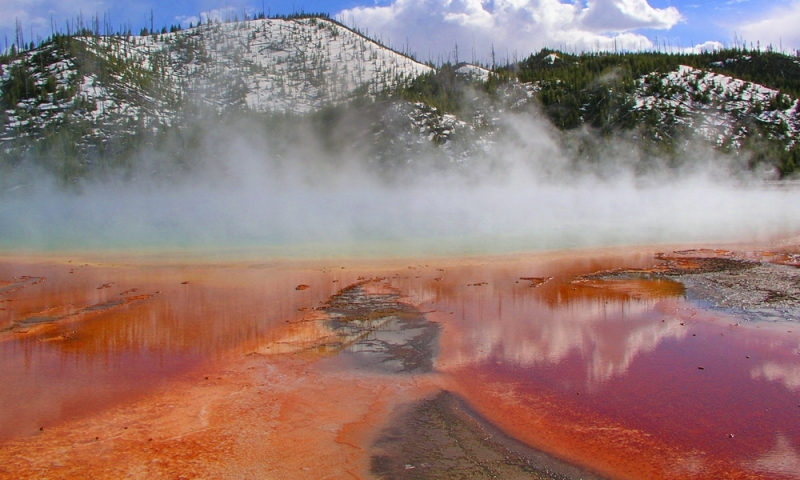
Grand Prismatic Spring is the largest hot spring in Yellowstone, and is considered to be the third largest in the world. The Hayden Expedition in 1871 named this spring because of its beautiful coloration, and artist Thomas Moran made water-color sketches depicting its rainbow-like colors. The sketches seemed exaggerations and geologist A.C. Peale returned in 1878 to verify the colors. The colors begin with a deep blue center followed by pale blue. Green algae forms beyond the shallow edge. Outside the scalloped rim a band of yellow fades into orange. Red then marks the outer border. Steam often shrouds the spring which reflects the brilliant colors. Grand Prismatic discharges an estimated 560 gallons of water per minute.

Excelsior Geyser is the third largest geyser in the world, and was once considered the park's most powerful geyser. It is now a dormant geyser since its last known major eruptions during the 1880s, when there were numerous eruptions up to 300 feet. The violent eruptions of the 1880s may have caused damage to the silicesous sinter lining, allowing gas leakage and the loss of thermal energy. No observed eruptions were known until 1985 when it erupted for two days, obtaining a height of 20-80 feet. Excelsior today is considered a hot spring, a productive thermal spring, discharging more than 4050 gallons of boiling water per minute. Numerous vents boil and churn the water within the crater, covering it in a dense layer of steam.

Other colorful springs include Turquoise and Indigo springs, known for their colors of pale and dark blue. Across the Firehole River from Excelsior and Grand Prismatic springs are a series of small isolated, pristine springs and mud pots. The Rabbit Creek drainage possesses some colorful and unusual features and most are unnamed. Caution should be exercised while exploring this vicinity since the ground is unstable and trails are not maintained.

Yellowstone National Park, WY Weather