Yellowstone Vacations courtesy of Flying Pig Adv's - The friendliest, most professional travel planning company you'll experience for families seeking adventure in the region. We work with the best outfitters, lodging organizations, guides and information resources to help you enjoy your trip to Yellowstone. Online booking or by phone, come see us!
Yellowstone National Park

Yellowstone: West Thumb & Grant Village

West Thumb & Grant Village

map button weather yellow pages print

NATURAL HIGHLIGHTS OF THE AREA

West Thumb of Yellowstone Lake

Members of the 1870 Washburn party noted that Yellowstone Lake was shaped like "a human hand with the fingers extended and spread apart as much as possible," with the large west bay representing the thumb. In 1878, however, the Hayden Survey used the name "West Arm" for the bay; "West Bay" was also used. Norris' maps of 1880 and 1881 used "West Bay or Thumb." During the 1930s, park personnel attempted to change the name back to "West Arm," but West Thumb remains the accepted name.

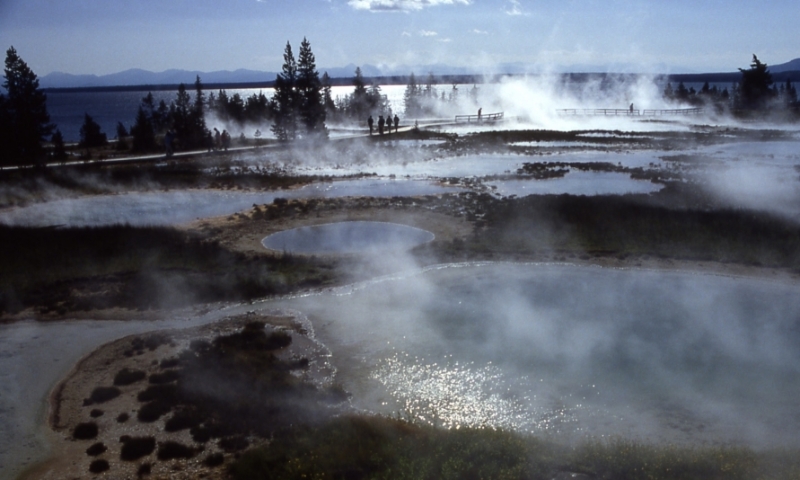
West Thumb Geyser Basin

While many of the park's features had been described by mountain men and other explorers, the West Thumb area was the first Yellowstone feature to be written about in a publication. Daniel T. Potts, a trapper in the Yellowstone region in the 1820s, wrote a letter to his brother in Philadelphia, Pennsylvania, regarding his experiences in this area. The letter was later corrected for punctuation and spelling and printed in the Philadelphia Gazette on September 27, 1827. Part of the letter describing the northern part of the West Thumb Geyser Basin, which is currently known as "Potts Basin" follows:

. . . on the south borders of this lake is a number of hot and boiling springs some of water and others of most beautiful fine clay and resembles that of a mush pot and throws its particles to the immense height of from twenty to thirty feet in height[.] The clay is white and of a pink and water appears fathomless as it appears to be entirely hollow under neath. There is also a number of places where the pure sulfur is sent forth in abundance[.] One of our men visited one of those whilst taking his recreation[.] There at an instant the earth began a tremendous trembling and he with difficulty made his escape when an explosion took place resembling that of thunder. During our stay in that quarter I heard it every day.

In 1869, the first scientific expedition to explore the Yellowstone area, the Folsom- Cook-Peterson Expedition, visited the West Thumb Geyser Basin. David Folsom described the area as follows:

Among these were springs differing from any we had previously seen. They were situated along the shore for a distance of two miles, extending back from it about five hundred yards and into the lake perhaps as many feet. There were several hundred springs here, varying in size from miniature fountains to pools or wells seventy-five feet in diameter and of great depth. The water had a pale violet tinge, and was very clear, enabling us to discern small objects fifty or sixty feet below the surface. A small cluster of mud springs near by claimed our attention. These were filled with mud, resembling thick paint of the finest quality, differing in color from pure white to the various shades of yellow, pink, red and violet. During the afternoon they threw mud to the height of fifteen feet. . . .

Historically, visitors travelling to Yellowstone would arrive at West Thumb via stagecoach from the Old Faithful area. At West Thumb, they had the choice of continuing on the dusty, bumpy stagecoach or boarding the steamship "Zillah" to continue the journey to the Lake Hotel. The boat dock was located near the south end of the basin near Lakeside Spring.

The West Thumb area used to be the site of a large campground, cabins, a photo shop, a cafeteria, and a gas station. This development was located immediately next to the geyser basin with the park road passing between the two. In an effort to further protect the scenic quality and the very resource that visitors were coming to see, the National Park Service removed this development in the 1980s.

Abyss Pool

In 1935, Chief Park Naturalist C.M. Bauer named Abyss Pool, a hot spring of the West Thumb Geyser Basin, for its impressive deepness. Bauer may have taken the name from Lieutenant G.C. Doane's 1870 description of a spring in this area: "the distance to which objects are visible down in [its] deep abysses is truly wonderful" (Bonney and Bonney, Battle Drums, p. 330). Abyss Pool may also be the spring that visitors referred to during the 1880s as "Tapering Spring" because of its sloping walls.

Nineteenth century observers were impressed with the pool's beauty. In 1871, F.V. Hayden reported that this spring's "ultramarine hue of the transparent depth in the bright sunlight was the most dazzlingly beautiful sight I have ever beheld" (Preliminary Reports, p. 101). And W.W. Wylie (see Wylie Hill) observed in 1882 that the spring's walls, "coral-like in formation and singular in shape, tinted by the water's color, are surely good representations of fairy palaces" (Yellowstone, p. 47).

Fishing Cone

Fishing Cone is a hot spring located in the West Thumb Geyser Basin. The Folsom party probably saw it in 1869, but the first recorded description of Fishing Cone comes from the 1870 Washburn Expedition. Party member Walter Trumball wrote about Cornelius Hedges's experience fishing:

A gentleman was fishing from one of the narrow isthmuses or shelves of rock, which divided one of these hot springs from the [Yellowstone] lake, when, in swinging a trout ashore, it accidentally got off the hook and fell into the spring. For a moment it darted about with wonderful rapidity, as if seeking an outlet. Then it came to the top, dead, and literally boiled (Overland Monthly, June 1871, p. 492).

From that time on, and perhaps even earlier, visitor after visitor performed this feat, catching fish from the cold lake and cooking them on the hook. Hayden Survey members did it in 1871, and the next year they named the spring "Fish Pot" or "Hot Spring Cone." Later names were "Fisherman's Kettle," "Fish Cone," "Fishpot Spring," "Crater Island," and "Chowder Pot." The name Fishing Cone came about gradually through the generic use of the term in guidebooks.

The cooking-on-the-hook feat at Fishing Cone soon became famous. For years, park Superintendent P.W. Norris (1877-1882) demonstrated it to incredulous tourists, and in 1894 members of Congress hooted at their colleagues who described the process. A national magazine reported in 1903 that no visit to the park was complete without this experience, and tourists often dressed in a cook's hat and apron to have their pictures taken at Fishing Cone. The fishing and cooking practice, regarded today as unhealthy, is now prohibited

Fishing at the cone can be dangerous. A known geyser, Fishing Cone erupted frequently to the height of 40 feet in 1919 and to lesser heights in 1939. One fisherman was badly burned in Fishing Cone in 1921.

Lodgepole Pine Forests & Fire

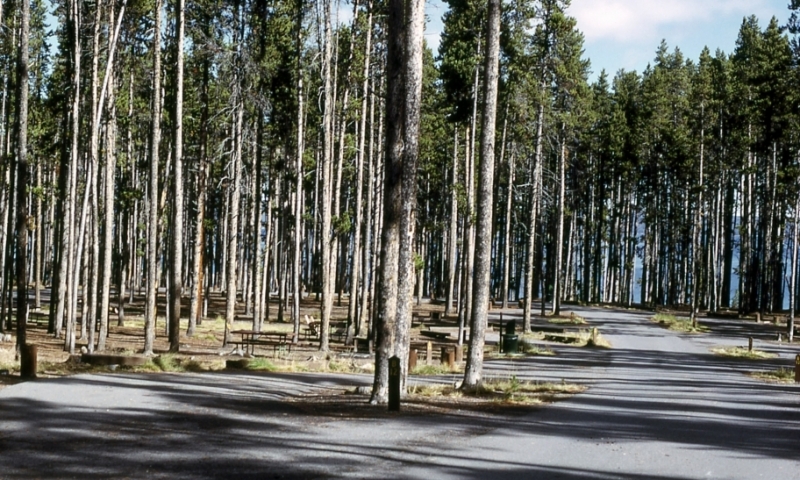
This area is in a lodgepole pine forest, and the fires of 1988 greatly affected this part of the park. Several trails including the Lake Overlook Trail, Duck Lake Trail, and Riddle Lake Trail provide excellent opportunities to examine the various stages of lodgepole pine forest succession and development as well as fire ecology.

On July 12, 1988, a small fire started near the Falls River in the southeastern corner of the park. For several weeks, the fire grew slowly as crews attempted to contain it. On August 20, the winds picked up. This day would later become known as "Black Saturday" because more acres burned on this day alone than in the entire history of Yellowstone prior to this day. During that week, high winds drove the fire for miles until it approached the Lewis River. Defying all conventional understanding of fire behavior and driven by 60 mph winds that gusted to 80 mph, the fire blew all the way across the Lewis River Canyon on August 23.

Firefighters were astounded. Even the most experienced Incident Commanders had never seen fire burn like it did in 1988. While the fires shocked the nation and the world, scientists had long known that a fire of this magnitude would burn through a lodgepole pine forest like Yellowstone's on an average of once every 300 years. In fact, lodgepole pine forests are adapted to fire. Some of the pine cones need the intense heat of fire to open the cones and drop the seeds for the next generation of forests. While fire is often difficult for people to understand, for the lodgepole pine forests it is as important and necessary as other natural processes like rain and sunshine, death and rebirth.

Cutthroat Trout Spawning Streams

Big Thumb Creek and Little Thumb Creek along with several other intermittent streams serve as cutthroat trout spawning streams, thus as major feeding areas for both grizzly and black bears during spawning season.

Heart Lake

Lying in the Snake River watershed west of Lewis Lake and south of Yellowstone Lake, Heart Lake was named sometime before 1871 for Hart Hunney, an early hunter. The name does not refer to the heart-like shape of the lake. During the 1890s, historian Hiram Chittenden learned from Richard "Beaver Dick" Leigh, one of Hunney's cronies, about the naming of the lake. Evidently, Capt. John W. Barlow (see Barlow Peak), who explored Yellowstone in 1871, made the incorrect connection between the lake's name and its shape. Chittenden wrote to Barlow, who could recall nothing about the naming, but Leigh "was so positive and gave so much detail" that Chittenden concluded that he was right. Chittenden petitioned Arnold Hague of the USGS to change the spelling back to "Hart Lake," but Hague refused, convinced the shape of the lake determined the name.

As for Hart Hunney, Leigh said that Hunney operated in the vicinity of Heart Lake between 1840 and 1850 and died in a fight with Crow Indians in 1852. Chittenden thought it was possible that Hunney was one of Capt. Benjamin Bonneville's men.

Isa Lake

Hiram Chittenden of the U.S. Army Corps of Engineers claimed to have discovered this lake on the Continental Divide at Craig Pass in 1891. Chittenden, who built many early roads in Yellowstone, was searching for a practicable route to locate his new road between Old Faithful and West Thumb. It was not until 1893 that Northern Pacific Railroad (NPRR) officials named the lake for Isabel Jelke of Cincinnati. Little is known about Jelke or about her relationship to Chittenden, the NPRR, and Yellowstone. Chittenden's 1916 poetic tribute to the lake and his discovery includes the puzzling line: "Thou hast no name; pray, wilt thou deign to bear/The name of her who first has sung of thee" (Verse, p. 53). Perhaps Isabel Jelke was already associated with the lake when Chittenden "discovered" it. Isa Lake is noteworthy as probably the only lake on earth that drains naturally to two oceans backwards, the east side draining to the Pacific and the west side to the Atlantic.

Craig Pass

Craig Pass, at 8,262 feet on the Continental Divide, is about eight miles east of Old Faithful on the Grand Loop Road. In 1891, road engineer Captain Hiram Chittenden discovered Craig Pass while he was surveying for the first road between Old Faithful and West Thumb. It was probably Chittenden who named the pass for Ida M. Craig (Wilcox), "the first tourist to cross the pass" on Chittenden's new road, on about September 10, 1891. At the time that her name was given to the pass, Ida Wilcox (1847-1930) had been married 24 years. So why did Chittenden use her maiden name? Perhaps it was to honor her singularly for being the first tourist to cross the pass. It is also possible that through his connection with the military, Chittenden knew her father (Gen. James Craig) or her brother (Malin Craig, Sr.) and was really honoring the Craig family.

DeLacy Creek

DeLacy Creek flows south from DeLacy Lakes to Shoshone Lake. Park Superintendent P.W. Norris named the creek in 1881 for Walter Washington DeLacy (1819-1892), the leader of a prospecting expedition that passed through the Yellowstone region in 1863. DeLacy, a surveyor and engineer, compiled the first accurate map of the Yellowstone area in 1865.

In 1863, DeLacy led a group of prospectors from Jackson Hole across the Pitchstone Plateau and discovered Shoshone Lake, which he named "DeLacy's Lake." He was the first to note the "strange" drainage of that lake south to the Snake River rather than west to the Madison River. But he did not publish his discoveries until 1876, which kept him from receiving credit for being the man who discovered Yellowstone and from leaving his name on present-day Shoshone Lake.

DeLacy also recognized the importance of Yellowstone's thermal features. In a published letter in 1869, he wrote: "At the head of the South Snake, and also on the south fork of the Madison [present-day Shoshone Lake and Firehole River], there are hundreds of hot springs, many of which are 'geysers'" (Raymond, "Mineral Resources," p. 142). In 1871, Hayden changed the name of "DeLacy's Lake" to "Madison Lake." In 1872, Frank Bradley criticized DeLacy for the "numerous errors" on his map and named the lake Shoshone.

Park Superintendent P.W. Norris felt sorry for DeLacy and named the present stream for him in 1881, stating:

The . . . narrative, the high character of its writer [DeLacy], his mainly correct descriptions of the region visited, and the traces which I have found of this party [campsite remains, etc.], proves alike its entire truthfulness, and the injustice of changing the name of De Lacy's Lake [to Shoshone Lake]; and fearing it is now too late to restore the proper name to it, I have, as a small token of deserved justice, named the stream and Park crossed by our trail above the Shoshone Lake after their discoverer (Fifth Annual Report, p. 44).

Factory Hill

Factory Hill is a 9,607-foot-high peak in the Red Mountains. By 1876, the peak was called "Red Mountain," a name that had originally been given to present-day Mount Sheridan by members of the 1871 Hayden Survey. Eventually, the name "Red" was applied to the entire small mountain range.

Members of the Hague parties named Factory Hill in about 1885 because N.P. Langford's description of steam vents near the mountain. In the June 1871 issue of Scribner's, Langford had written: "Through the hazy atmosphere we beheld, on the shore of the inlet opposite our camp, the steam ascending in jets from more than fifty craters, giving it much the appearance of a New England factory village" (p. 120).

Lewis River

This river drains Shoshone and Lewis lakes and is a tributary of the Snake River. In 1872, members of the second Hayden survey called the river "Lake Fork" because it was a fork of the Snake that began in those two lakes. An 1876 map showed the river marked "Lewis Fork" (of the Snake), named from Lewis Lake.

Red Mountains

This small range of mountains, located just west of Heart Lake, is completely contained within the boundaries of Yellowstone National Park. In 1871, F.V. Hayden named present-day Mount Sheridan "Red Me National Park.

YD Flies - 20% Below Wholesale, Top Quality - 20% below wholesale everyday! These first quality hand-tied flies are the best deal on the 'web. It just so happened that a very well-known fly distributor bought too many that sat around unsold. Brand names like Skykomish and Rene Harrop are among our unique mix of dries, nymphs, wets & streamers.

Yellowstone National Park, WY Weather