Mountain Ranges
Yellowstone National Park: Rocky Mountains
Two million years of violent volcanic eruptions, fueled by the subterranean presence of hot and molten rock in the Yellowstone hotspot, produced the spectacular features seen today at Yellowstone National Park. The park contains geyser and hotspring systems of extraordinary size and expanse.
The Yellowstone is that high, mountain-girt plateau lying astride the crest of the Rocky Mountains in the northwest corner of Wyoming. An area of such natural beauty and unusual features that "Wonderland" has long been its fitting sobriquet. There, within an area larger than the states of Delaware and Rhode Island combined, are superlatives of scenery, geology, and wildlife in a grandly primeval setting, a very appropriate locale for our first, largest, and most influential national park.
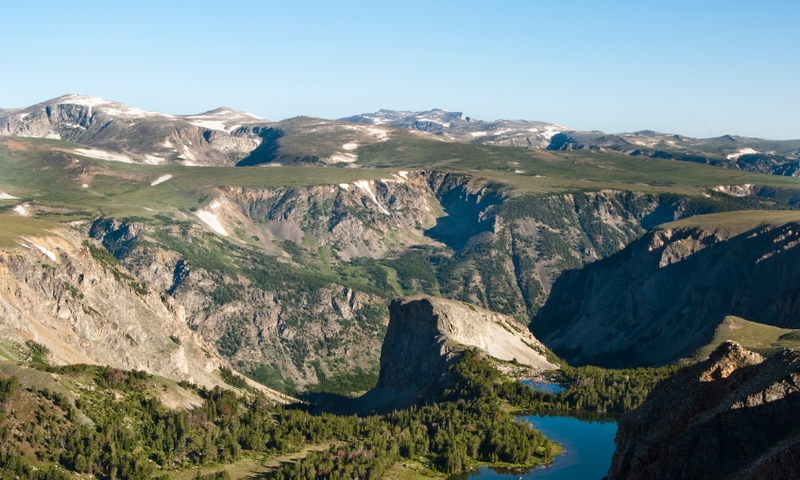
Visitors are often surprised by the Yellowstone Plateau's relatively flat, undulating topography and its paucity of high mountains. They envision the Rocky Mountains to be a continual chain of mountains that come to rising peaks in heights of ten thousand feet plus. In Yellowstone, the plateau exists, in part, because the entire region bulged upward over the past few million years as this part of North America moved over the Yellowstone hotspot, a rising plume of hot and molten rock within Earth's mantle and crust.
During the past 2 million years, the hotspot generated three incredibly large eruptions that blew huge craters in the ground. These giant volcanic craters, known as calderas, erupted on a scale unknown in modern time. Huge amounts of molten rock exploded skyward, destroying mountain ranges, incinerating anything within dozens of miles, and dumping volcanic ash over half of North America. Much of central Yellowstone National Park, including much of Yellowstone Lake, sits within the 45 by 30 mile caldera created by the last big blast about 630,000 years ago.
The rim of this vast crater is apparent in some locations. In many other places, the caldera was filled in by smaller lava and ash flows that erupted since the entire caldera last exploded, leaving it virtually hiden from the naked eye. Glacial ice about 3,500 feet thick covered Yellowstone repeatedly during the Ice Age. The glaciers scoured and smoothed the landscape, putting finishing touches on the modern Yellowstone Plateau, including Yellowstone Lake.
The southern rim of the Yellowstone calder is most apparent. Driving north in Yellowstone from the south entrance, you will pass the continental divide at 7,988 feet above see level. At this point you are entering the Yellowstone caldera. The continental divide of North America runs roughly diagonally through the southwestern part of Yellowstone. The divide is the topographic ridgeline that bisects the continent between Pacific Ocean and Atlantic Ocean water drainages. For example, the Yellowstone River and the Snake River both originate close together in Yellowstone National Park. However, the headwaters of the Snake River are on the west side on the continental divide and the headwaters of the Yellowstone River are on the east side of that divid. The result is that the waters of the Snake River head toward the Pacific Ocean and the waters of the Yellowstone head for the Atlantic, via the Gulf of Mexico.
Yellowstone remains alive as a tremendous amount of heat flows from the ground. The entire floor of the caldera huffs upward and puffs downward over decades as molten rock, hot water, and steam move through conduits at various levels beneath the caldera, from a few miles deep in the crust to perhaps a couple hundred miles deep in the mantle. The shallowest hot water and steam erupt to the surface as everchanging geysers, springs, mud pots, and steam vents. Movements of molten rock and superheated water at somewhat greater depths can generate thousands of earthquakes, mostly small to moderate ones within the caldera. Other quakes, ranging from small to disastrous, occur because Earth's crust is being stretched apart in a wide area of the western United States.
The Rocky Mountains sit east of the seismic belt. Yellowstone sits to the west of the seismic belt, a region known as the Basin and Range Province, an area of the interior western United States that is being stretched apart. This stretching is responsible for creating the Teton, Wasatch, Hebgen Lake, and other powerful faults within the Intermountain Seismic Belt. Most often the earthquakes created at these faults are small to moderate, but also some are the strongest in U.S. history. The magnitude 7.5 Hebgen Lake disaster northwest of Yellowstone in 1959 and the 7.3 Borah Peak, Idaho quake in 1983 created major changes in topography and in Yellowstone's geyser region. The Hebgen Lake quake was the largest historic earthquake in the Rocky MOuntains and the Intermountain Seismic Belt.


network of Travel Guides